CRO: What it is and how to get started
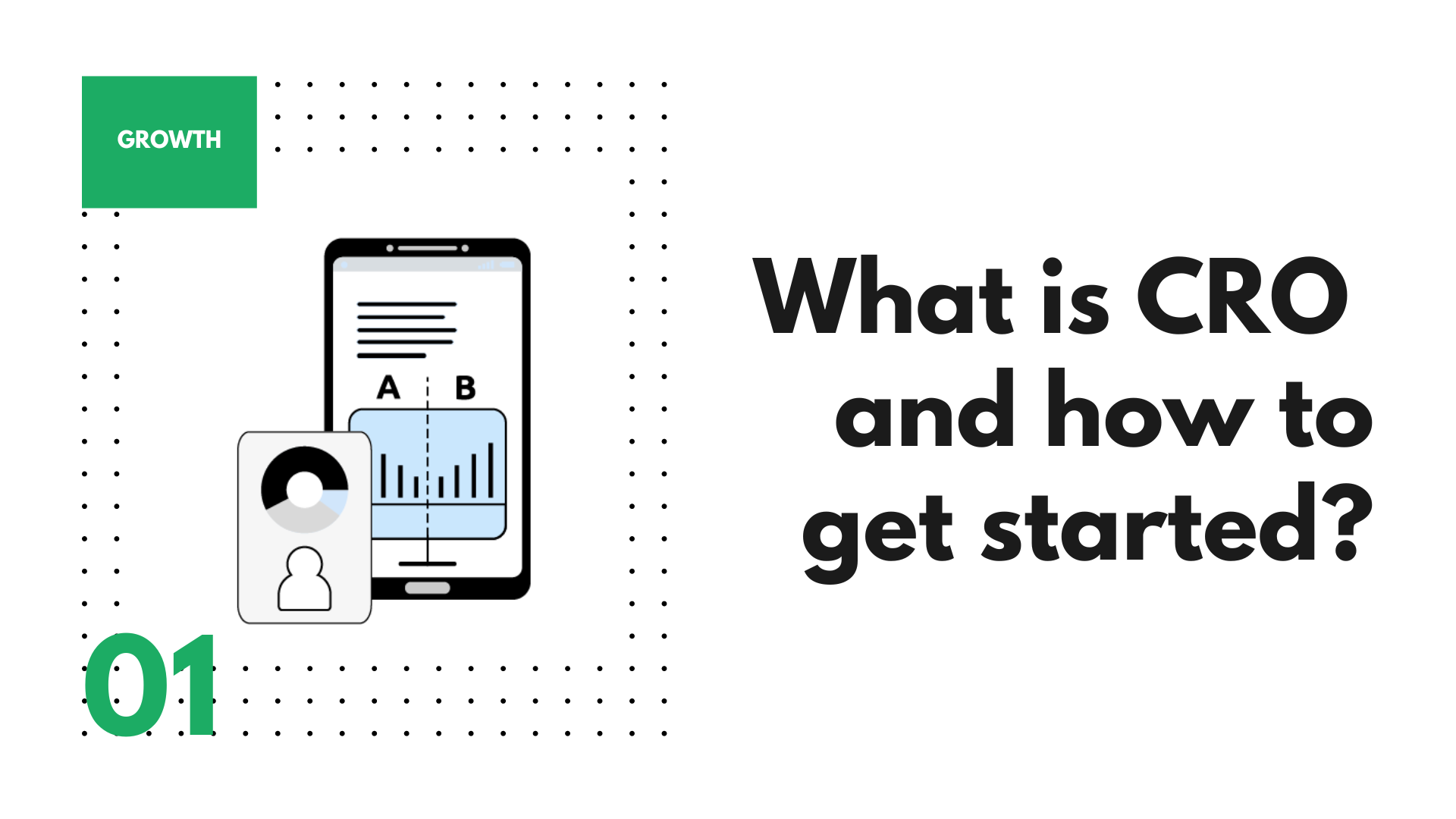
Conversion rate optimization (CRO) is the process of improving the percentage of visitors to your website who take a desired action, typically leading to a purchase. In the context of e-commerce, CRO specifically aims to optimize your online store to boost sales. As an E-commerce business, your goal is simple – to grow your online revenue. CRO is a data-driven process that involves testing and experimentation. It is also important to have a clear understanding of your customers and their needs to be successful with CRO. If you want to improve your website’s CRO, there are various actions you can take on different parts of your site. For example, you can enhance your product pages to boost sales, streamline the checkout process, improve your blog, add personal touches, use pop-up messages, apply psychological principles, and explore various other strategies. Why is CRO important? CRO is important because it can help you increase your website’s revenue and profitability. By improving your conversion rate, you can get more value from your existing traffic. CRO can also help you improve your website’s user experience and make it more likely that visitors will return to your site in the future. With a good CRO strategy, you can harvest multiple benefits: CRO will save you money Gain insights about your customer’s behavior Improve ROI and marketing efficiency Enhance your site’s usability, navigation, and user experience Make decisions based on data and insights, not instinct How to start optimizing your conversion Now you’ve learned the benefits of CRO, but where to start? We’ve broken down key steps into the following sections: process, tools and testing targets to give you an overview. Process CRO places a huge emphasis on testing and experimentation which should be conducted using the scientific method. Let’s look at the steps involved: 1) Gather data & insights Data and insights are always your starting point. At this stage, you’d want to gather both qualitative & quantitative data as much as possible, to help you get an overview of your conversion problem. Funnel & web analytics: From when the customer comes to your website to perform the action (e.g complete a checkout), the journey often involves several, interconnected steps. Like fixing a leaking pipe, you’ll want to break down the funnel and learn where your customers drop off the most. UX heuristic evaluation: Sometimes your conversion problem is as simple as it’s not user friendly enough. Is the navigation clear for customers? Is the message consistent? A UX heuristic audit gives you clues of conversion problems resulting from usability issues. Market research: Each industry has its unique landscape and consumer behavior. Doing competitive research to understand your general positioning, offering and pricing and consumer preference helps you assess conversion from a high business level. 2) Formulate hypotheses Once you consolidate all the findings, the next step is to formulate a hypothesis. We are not jumping into complicated statistical hypotheses yet, but at bare minimum, your hypothesis should consist of three important elements – reasoning, testing variable/action and the desired result. The sentence structure might look like this: “Based on (your finding), we believe we can achieve (desired result) by (testing variable/action).” Let’s try with an example: “Based on the fact that social proof gives consumers confidence in product quality, we believe we can increase more purchases by adding customer feedback on product pages.” 3) Run a test After narrowing down the hypotheses and areas you’d like to test, you’ll then move to designing and performing the tests. AB testing (single variate testing) or multivariate testing are the most common methods used. You’ll want to make sure you have proper tools to split the controlled/testing environment and accurate data tracking to help you monitor the results. 4) Analyze Now it’s time to validate your ideas with data evidence. Judging by the result, is your hypothesis correct? If not, how can you potentially explain the reason? Is there a new hypothesis? Was the experiment flawed? This is the most crucial (yet sometimes neglected) step to learn from the experiments and adjust your testing plan. 5) Reiterate and repeat Although we call it step 5 here, CRO is indeed not a linear process. Once you gain some thoughts from the previous step, it’s time to decide how to carry the next step. Was the experiment successful? Great! Can you take it to the next level? Should you move on to test other new ideas? If not, should you form a new test based on the corrected hypothesis? CRO is a cycle of continuous hypothesis, testing and learning. CRO analytic tools There are many tools to help you conduct CRO smoothly. Below we will provide a few examples: 1. Quantitative user analytic tools A quantitative analytic tool helps you understand through numerical data, what happened on your website and/or app. You can use such tools to answer: How engaged are your customers? Which User groups are engaging less? How long did your customers visit? How many pages have they viewed? How many customers go through a specific funnel? Where do they drop off? What are the most popular paths of your customers? What products or pages receive the most attention? Some of our best picks for quantitative user analytic tools include: Google Analytics 4 Google Analytics is the most commonly used analytics platform in the world. Recently, Google introduced the new Google Analytics 4 (the Universal Analytics , i.e. old GA, will be sunsetted by Jul 1, 2023. If you haven’t migrated to GA4 yet, let us give you a hand). Not only can you analyze traffic, but the new GA4 also offers enhanced insights on customer journeys and makes it easier to do funnel analysis, path exploration etc. Best of all, it’s free! Mixpanel Mixpanel is a powerful self-service, event-based analytics tool that provides valuable customer insights with the ease of data visualization. It is one of the popular analytic tools. They currently help the world answer 81 million product
CRO: What it is and how to get started
As an ecommerce business, attracting visitors to your website is only part of the job. You also need to help those visitors find what they need, feel confident in their decisions, and complete their purchases. You might already be investing in SEO, paid advertising, social media, and other marketing channels to bring people to your website. But what happens when traffic increases and sales remain the same? The problem may not be how many people visit your website. It could be what happens after they arrive. That is where conversion rate optimization (CRO) comes in. What Is Conversion Rate Optimization (CRO)? Conversion rate optimization, or CRO, is the process of improving a website or app to encourage more visitors to complete a desired action. For an ecommerce business, that action is usually a purchase. For other businesses, it might be submitting an enquiry form, booking a consultation, signing up for a newsletter, or creating an account. The goal is not simply to increase a percentage. It is to understand what customers need, identify what makes it difficult for them to take action, and improve the experience based on evidence. How to Calculate Conversion Rate A basic conversion rate formula is: Conversion rate = (Number of conversions ÷ Number of eligible visits or users) × 100 For example, if 10,000 eligible sessions generate 200 purchases, the session-based purchase conversion rate is 2%. Be consistent about the denominator. A rate calculated using sessions is not the same as one calculated using unique users. In Google Analytics 4 (GA4), for example, you can review both Session key event rate and User key event rate. The appropriate measure depends on the question you are trying to answer and how your key events are configured. Why Does CRO Matter? A website can attract plenty of visitors without turning that traffic into enough sales or enquiries. CRO helps you understand why this happens and where improvements could make a difference. A well-planned CRO strategy can help your business: Understand customer behaviour: Learn what visitors look for, which pages they use, and where they encounter difficulties. Make better use of marketing spend: Improve the experience for visitors you are already investing in attracting. Make the website easier to use: Help customers navigate pages, understand products, and complete important actions. Make decisions based on evidence: Use analytics, customer feedback, and testing rather than relying on assumptions. Improve the customer experience: Reduce unnecessary friction before, during, and after a purchase. CRO should bring together data and an understanding of people. The numbers can show you where a problem might exist, but you still need to understand why it happens before deciding what to change. How to Get Started with Conversion Rate Optimization CRO works best as an ongoing process rather than a one-off website redesign. Instead of changing several elements at once and hoping for better results, follow a structured approach. 1. Gather Data and Understand the Problem Before making changes, find out how visitors currently use your website. Start with quantitative data, which helps you understand what is happening, and qualitative research, which can help explain why. Website analytics and conversion funnels Use Google Analytics 4 (GA4) to examine how visitors move through your website. For an ecommerce business, you might review a journey such as: Product listing → Product detail page → Add to cart → Begin checkout → Purchase Look at how many users reach each step and where the biggest drop-offs occur. GA4’s Funnel Exploration helps you visualise the steps users take to complete a task and identify where they leave the journey. For example, if many users add products to their carts but relatively few complete checkout, investigate the checkout experience before making changes to unrelated pages. You can also compare relevant segments, such as device category, traffic source, landing page, and new versus returning users. A problem affecting mobile users may not be obvious when you look at all visitors together. User experience (UX) reviews Analytics can show where visitors leave, but it may not tell you exactly why. Review your website as a customer would. Can visitors find the main navigation? Are product descriptions clear? Are shipping fees and delivery information easy to find? Is the checkout process straightforward on a mobile phone? A usability review can help identify confusing navigation, unclear calls to action, unnecessary steps, and other barriers that may affect conversions. Customer feedback and user research Customer surveys, support enquiries, usability tests, and feedback from sales teams can reveal issues that analytics alone might miss. For example, visitors may abandon a purchase because delivery costs appear too late in the process, or they may hesitate because product information does not answer their questions. Combine these findings with analytics to build a clearer picture of the problem. Competitor and market research Review how competitors present their products, pricing, delivery policies, returns, and customer reviews. This can help you identify areas where your own website could provide a clearer or more useful experience. Use competitor research to generate ideas, not to assume that what works for another business will automatically work for yours. 2. Form a Clear Hypothesis Once you have gathered your findings, decide what you want to test and why. A useful hypothesis should explain: What problem you identified. What change you plan to make. Why you expect that change to help. Which result you will measure. A simple format is: Based on [what we found], we believe that [proposed change] will improve [desired outcome] because [reason]. For example: Based on our finding that customers struggle to locate delivery information on product pages, we believe displaying delivery details more clearly will increase add-to-cart rates because customers can make more informed purchase decisions. This gives your team a clear reason for running the test and a result to evaluate afterwards. Prioritise ideas based on their potential business impact, the evidence supporting them, the effort required, and the risk involved. A minor design change may be easy to implement, but a checkout issue affecting many customers could
Launching conversion rate optimization (CRO) service
Whether you want to improve marketing efficiency but are at an early stage with CRO or want to go beyond short-term conversion tactics, here’s our new service for you.